


Most people do not start by asking about custom implants. They start with a no.
No, you don't have enough bone. No, implants won't work for you. No, not without several grafting surgeries first, and maybe not even then.
For many patients, that answer comes after years of missing teeth or wearing a denture that never quite stays put. Some have already had a graft that didn't take, or an implant that failed.
That is usually where the IPS conversation starts.
At Stone Dental Implant Center, we see patients who have been told they are out of options. Many have heard about IPS implants and want to know one simple thing: what are they, and could they work for me?
The simple answer is this: IPS implants are custom titanium implants designed from your own CT scan, 3D-printed to fit your jaw, and anchored to the strongest bone you still have, so they don't need the bone height a standard implant does.
The more honest answer is that IPS implants are not right for everyone. They are a specialized solution for a specific group of patients, and the right choice depends on your bone, your gums, your health, your history, and your goals.
That is why the planning matters as much as the implant.
What Are IPS Implants?
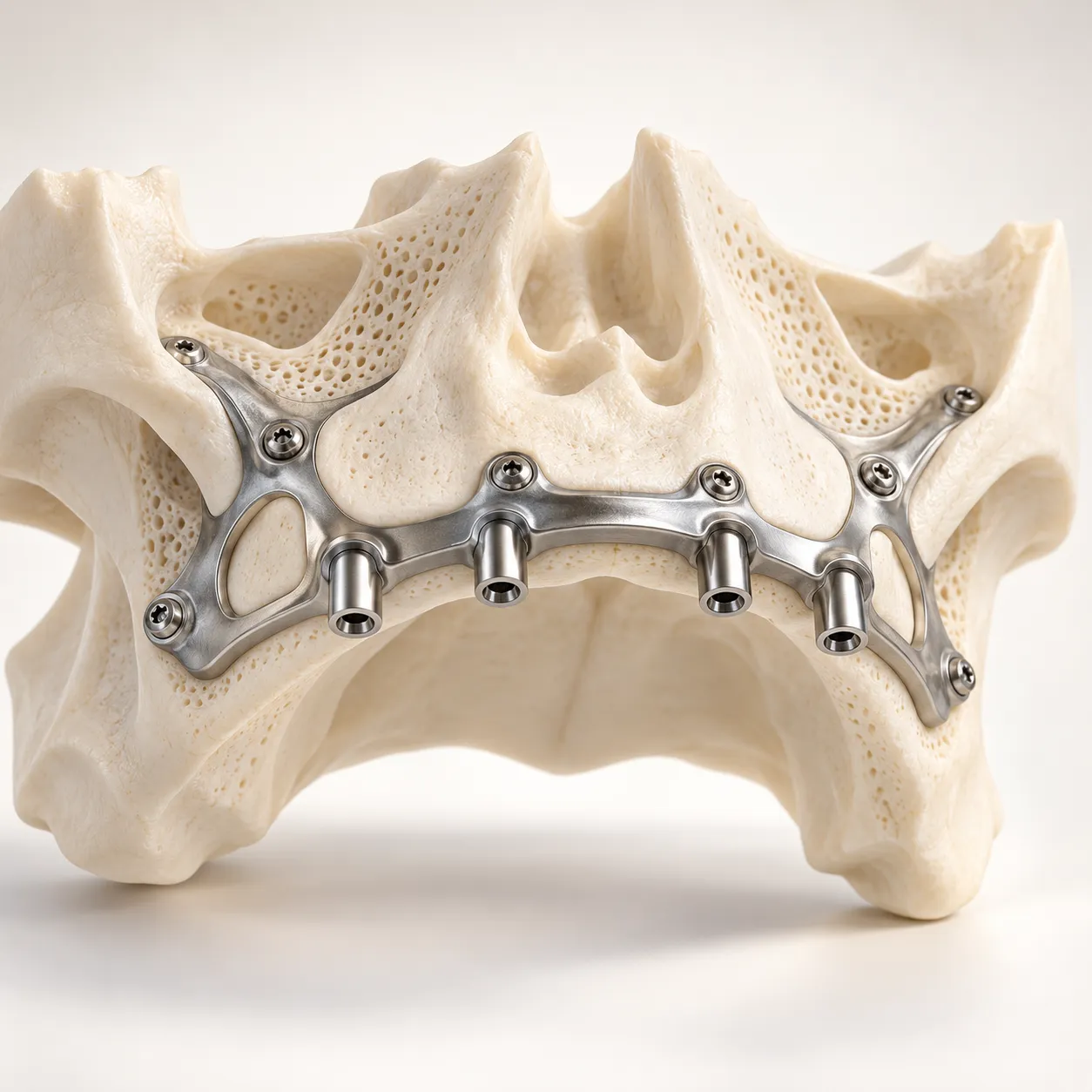
IPS stands for Individual Patient Solutions, a line of patient-specific implants made by the KLS Martin Group. The dental version, the IPS Implants® Preprosthetic, is a one-piece titanium framework built for one patient only. (source)
Instead of going into the jawbone like a standard implant, it rests on the bone, beneath the gum. Small posts pass through the gum to hold a fixed bridge of new teeth.
Implants that sit on the bone this way are called subperiosteal implants. IPS is a modern, fully digital version of that idea.
The important word is “custom.”
Every IPS implant starts from a CT scan of your jaw. It is planned virtually, manufactured for your anatomy, and fixed to the parts of your jaw that can carry the load. Nothing about it is off the shelf.
Why Can't Some Patients Get Standard Implants?
A standard dental implant is a titanium post placed inside the jawbone. To hold it securely, the bone needs enough height and width.
The problem is that bone doesn't wait. Once a tooth is lost, the ridge that held it starts to shrink. A systematic review of human studies found the ridge loses 29–63% of its width and 11–22% of its height within six months of an extraction, with most of the change happening in the first three to six months. (source)
Years of missing teeth, or a denture pressing on the gums, can take that further. Eventually there may not be enough bone left for a conventional implant.
The usual answer is to rebuild bone first with bone grafting or a sinus lift. For many patients, that works well.
But for patients with severe bone loss, failed grafts, or failed implants, rebuilding can mean multiple surgeries and many months of waiting. And sometimes it simply isn't realistic.
The Biggest Difference: Standard Implants Go Into Bone, IPS Implants Rest On It
A standard implant asks the jaw to make room for it. An IPS implant is designed around what the jaw already has.
Rather than relying on the thin ridge where your teeth used to be, an IPS framework is fixed with screws to the sturdy buttresses of the face and jaw. In the upper jaw, that can include the bone beside the nose and toward the cheekbone. In the lower jaw, it can include the body of the jaw and the bone toward the back. (source)
In the published IPS cases, between 13 and 22 screws were used to secure each implant, and a provisional bridge was attached at surgery with no loading restrictions from the day of placement. (source)
That last part matters: a stable framework, from day one.
IPS implants are powerful when the case calls for them. They are not a shortcut around diagnosis.
How Are IPS Implants Made?
Each IPS implant follows a fully digital workflow.
It begins with a CT scan of your jaw. That scan is turned into a 3D model, and the implant is planned virtually around your exact anatomy: where it sits, where each screw goes, and where the posts for your teeth will come through the gum.
The framework is then manufactured by selective laser melting, a form of 3D printing, from medical-grade titanium alloy. (source)
Digital design is what makes the fit possible. Reviews of modern custom subperiosteal implants describe frameworks made to roughly millimeter-level precision, something older casting methods could not achieve. (source)

Aren't Subperiosteal Implants an Old Idea?
Yes, and that history is worth knowing.
Subperiosteal implants date back to the 1940s. Early versions were cast from cobalt-chromium using impressions of the jaw. They were bulky, often fit poorly, and had high long-term failure rates from gum breakdown, infection, and fractures. Once modern implants and bone grafting arrived in the 1980s, they largely fell out of use. (source)
What has changed is not the idea. It is the technology.
3D imaging, virtual surgical planning, and additive manufacturing have replaced impressions and casting. The material is titanium. The fit is designed digitally. The fixation is planned to the bone that can actually carry the load.
IPS implants share a name with the old designs. The way they are planned, made, and secured is very different.
Who Is a Good Candidate for IPS Implants?
IPS implants are not a first-line treatment. They are designed for patients when conventional implants aren't a realistic option.
They may be a good fit if you have:
- Severe bone loss in the upper or lower jaw, often after years of missing teeth or wearing dentures
- Bone grafts or implants that have failed before
- A strong wish to avoid extensive grafting, or health reasons that make multiple surgeries a poor choice
- Bone defects after tumor surgery or injury, often as part of maxillofacial reconstruction
These indications are drawn from the published literature, which also describes their use in medically complex patients, evaluated case by case. (source) (source)
IPS implants can be more challenging when the gum tissue over the bone is thin or scarred, since good soft-tissue coverage is essential. (source) And if you have enough bone, a standard implant or All-on-X is still the better-studied choice.
Sometimes the best plan is not IPS at all. Sometimes it is a graft, a sinus lift, or a standard full-arch approach.
Change what needs changing. Choose the simplest option that will truly last.
What We Look at Before Recommending IPS
This is where case selection matters.
Before we decide whether a patient is an IPS candidate, we look at more than how much bone is missing. We evaluate the shape and quality of the remaining bone, the thickness and health of the gums, the sinuses, nerve position, your bite, any previous grafts or implants, your medical history, and how you care for your teeth at home.
These details help answer the real question: what is the most reliable way to give you fixed teeth, with the least surgery that still makes clinical sense?
A patient with moderate bone loss may do beautifully with a graft and standard implants. A patient with severe loss and two failed grafts may be exactly who IPS was designed for.
That is why we don't start with the implant. We start with the scan.
What Does the Research Say?
The evidence on custom 3D-printed subperiosteal implants is encouraging, but it is still early.
A 2024 systematic review of 13 studies and 227 patients found that 97.8% of implants were still in function at a weighted average follow-up of about 21 months. (source)
In the published IPS case series, none of the five patient-specific implants failed, with follow-up reaching 68 months, and no screw loosening, loss of stability, or peri-implantitis was observed. (source)
A multicenter study of 40 patients with custom upper-jaw implants of this type found that every patient completed their final restoration, with high satisfaction scores, including an average rating of about 9 out of 10 for appearance. (source)
A small randomized trial in severely resorbed lower jaws reported that all ten 3D-printed implants survived the first year. (source)
That is promising. It is not the whole story.
Reviewers rate the overall certainty of this evidence as very low, because most studies are small and observational, and they call for longer-term data. (source) Standard implants have decades of research behind them. Custom subperiosteal implants have years.
That is exactly why careful case selection and an experienced surgeon matter so much.
What Are the Risks?
The most common issue is the gum thinning or pulling back so part of the framework shows.
The 2024 review found partial exposure in 25.6% of implants and soft-tissue or persistent infection in 5.3% of patients. (source)
Exposure does not necessarily mean the implant will be lost. (source) In the 40-patient study, patients with partial exposure did not see it as a functional or cosmetic problem. (source)
Still, it is a risk to take seriously. Careful soft-tissue handling during surgery, good home care, and regular maintenance visits all help reduce it.
We would rather talk about this before treatment than after.
When Is Bone Grafting or Another Option the Right Choice?
IPS is one tool. It is not the only one.
Bone grafting rebuilds your own bone so standard implants can be placed. It is well established, and for many patients it is the right first step. In severe cases, it can mean several surgeries and longer healing.
Zygomatic implants use long implants anchored in the cheekbone for the upper jaw. They pass through the sinus region, while a subperiosteal framework rests on the remaining bone without entering the sinus. (source)
IPS implants offer a custom, graft-free option in a single surgery for carefully selected patients, in either jaw.
Still deciding whether implants are worth it compared with a denture? Our guide to dental implants vs. dentures covers the basics.
The right treatment is not the newest one. It is the one that fits your anatomy and solves the actual problem.
What Does Treatment Look Like?
Every case is different, but the path usually follows the same steps.
Consultation and CT scan. Dr. Stone reviews your history and 3D imaging to confirm whether IPS is the right fit, or whether a simpler option will work.
Virtual planning. Your implant is designed digitally with KLS Martin's engineers, including where each screw and post will go.
Custom manufacturing. The framework is 3D-printed in titanium for your jaw alone.
Surgery under sedation. The implant is placed and secured in one procedure.
Your teeth. In most cases, temporary teeth are attached after placement, followed by your final teeth once healing is complete.
How Much Do IPS Implants Cost?
Because every IPS implant is designed and manufactured for one patient, cost depends on your case: one jaw or both, the extent of bone loss, sedation, and the type of final teeth.
You receive an itemized quote after your CT scan and consultation, so you know exactly what is included before anything begins. Monthly payment plans are available, and you can review insurance and financing options ahead of time.
The value is in the planning and the execution. The implant matters, but it is only one part of the result.
Final Takeaways
- IPS (Individual Patient Solutions) implants are custom titanium implants by KLS Martin, designed from your CT scan and 3D-printed to fit your jaw.
- Unlike standard implants, they rest on the bone under the gum and are anchored to the strongest areas of the jaw.
- They are designed for patients with severe bone loss, failed grafts or implants, or bone defects, not as a first-line treatment.
- Early research is encouraging, with about 98% of custom subperiosteal implants functioning at around 21 months, but long-term evidence is still limited.
- The most common risk is gum recession that exposes part of the framework, which is managed with careful surgery and maintenance.
- If you have enough bone, a standard implant or All-on-X remains the better-studied choice.
- The first step is not choosing an implant. It is a CT scan and an honest evaluation.
If you've been told you don't have enough bone for implants, start with a free virtual consultation. Send us your records, tell us what you've been through, and we'll help you understand whether IPS custom implants make sense for you. Stone Dental Implant Center is in Westlake, serving Southlake, Keller, Trophy Club, and all of DFW.
Research References
- Gellrich NC, Korn P, Jehn P, Neuhaus M, Lentge F, Rahlf B. Exceptional cases demand exceptional personalized solutions: the next level in dental rehabilitation. Journal of Personalized Medicine. 2024;14(3):294. https://doi.org/10.3390/jpm14030294
- Anitua E, Eguia A, Staudigl C, Alkhraisat MH, et al. Clinical performance of additively manufactured subperiosteal implants: a systematic review. International Journal of Implant Dentistry. 2024;10:4. https://doi.org/10.1186/s40729-024-00521-6
- Van den Borre C, De Neef B, Loomans NAJ, et al. Patient satisfaction and impact on oral health after maxillary rehabilitation using a personalized additively manufactured subperiosteal jaw implant (AMSJI). Journal of Personalized Medicine. 2023;13(2):297. https://doi.org/10.3390/jpm13020297
- Tan WL, Wong TLT, Wong MCM, Lang NP. A systematic review of post-extractional alveolar hard and soft tissue dimensional changes in humans. Clinical Oral Implants Research. 2012;23(Suppl 5):1–21. https://doi.org/10.1111/j.1600-0501.2011.02375.x
- Albash Z, Khalil A, Baccouche I, Kashkash W, Almohammad G. Customized subperiosteal dental implants: a state-of-the-art narrative review. The Open Dentistry Journal. 2026;20:e18742106425818. https://doi.org/10.2174/0118742106425818260119104810
- Darwish SA, El-Mohandes WA, Abd Rabbo BED. Clinical and radiographic assessment of milled versus 3D-printed patient-specific subperiosteal implants for atrophic mandibular ridges: a randomized clinical trial. Cureus. 2025;17(3):e80326. https://doi.org/10.7759/cureus.80326